
We covered the viral drink itself, a spoon of plain gelatin stirred into warm water, in an earlier piece, The "Horse Gelatin Trick": What's Actually in the Viral Recipe. This article is about the other half of the story: the paid ads now riding on that phrase, the supplements they sell, and the science of the ingredient they keep invoking but rarely contain.
The Short Version
Gelatin and collagen peptides are the same protein cut to different lengths; peptides dissolve cold and are the form most human trials used. Both are absorbed. The trial results are real but modest and mostly industry-funded. The gummies advertised under the "horse gelatin" name list botanical blends with no gelatin and ingredient lists that change between storefronts, so we don't link to them. A collagen-peptide powder with a full Supplement Facts panel is the honest version of the purchase.
What the word "horse" is doing in the ad
Gelatin and horses do share one mundane history: gelatin has long been sold as a horse-feed additive on the folk belief that it strengthens hooves. A 1977 controlled trial fed young Shetland ponies gelatin at two doses (30, then 90 g per 100 kg of pony) over two 28-day periods and measured hoof growth, strength, moisture and mineral content. Gelatin changed none of them; how much the ponies ate did.[1] Whether or not that is where the viral phrase came from, it describes a product for horses, not one from horses. Retail gelatin in the United States comes from cattle and pig hides and bones, with a smaller share from fish skin.
In the funnels we opened on October 7, 2026, the word "horse" is never explained, and gelatin is absent from every label we could find:
- HorseFil. At least four sites, each presenting itself as the official store, sell a 30-count gummy under this name, with three different ingredient lists between them; maca and an arginine- or citrulline-type amino acid are the only constants. None prints a per-ingredient amount or a serving size, and none lists gelatin. Three show $158 for two bottles, $207 for three and $294 for six (or defer to checkout); a fourth shows $158, $177 and $234. All mention a 60-day guarantee. One gives a Manhattan office address and credits a physician "reviewer" while stating elsewhere that it has no doctor on staff. A separate site uses the same name for a feed supplement for actual horses.
- HorseBoost. Promoted in a July 2026 press release naming a Lakeland, Florida distributor, this gummy at least prints a panel: a nine-ingredient blend totaling 82 mg per gummy, of which only caffeine (5 mg) is quantified, leaving maca, muira puama, catuaba, green tea extract, ashwagandha, L-arginine, tribulus and the rest to share 77 mg.[2] It is the same panel, from the same distributor, as the JellyFil gummy we covered earlier. No gelatin there either.
None of these gets a link from us: a formula that depends on which copy of the website you landed on can't be evaluated, let alone recommended.
Collagen, gelatin, collagen peptides: one protein, three lengths
Collagen is the structural protein in skin, tendon, bone and cartilage: a tightly wound triple helix that won't dissolve in water. Heat it in water with acid or alkali and the helix unwinds into long fragments. That's gelatin. Cut those fragments much shorter with enzymes and you have what labels call hydrolyzed collagen or collagen peptides.[3]
Length is the whole difference. A materials-science paper puts commercial gelatin at roughly 20,000 to 100,000 daltons depending on grade; collagen peptides sit around 3,000 to 6,000.[3][4] Long chains tangle into a network when cooled, which is why gelatin sets a dessert and needs warm liquid to dissolve. Short chains can't, so peptides stir into cold water and stay liquid. Neither is a complete protein: USDA data lists zero tryptophan in dry gelatin, and the peptide tub we checked prints "Collagen is not a complete protein. Do not use to replace dietary protein" on its front panel.[5]
Does the length matter once you swallow it?
Less than either side's marketing suggests. A 2022 study in Food Chemistry gave nine volunteers plain gelatin, a standard gelatin hydrolysate and a low-molecular-weight hydrolysate and tracked collagen-specific fragments in their blood. Plain gelatin raised the dipeptide prolyl-hydroxyproline to about 15.5 nmol/mL at two hours; both hydrolysates pushed free hydroxyproline higher (roughly 151 and 169 nmol/mL versus 94), and only the finest-cut product significantly raised both dipeptides measured. The authors concluded that gelatin is useful "as effectively as" the standard hydrolysate, while the finer cut held a measurable edge.[6]
A 2017 trial points the same way: eight healthy men took 5 g or 15 g of vitamin-C-enriched gelatin, or placebo, an hour before six minutes of rope-skipping, three times a day for three days, and the 15 g dose doubled a blood marker of new collagen synthesis.[7] Eight people and a surrogate marker, but the pantry product is not inert.
What the collagen-peptide trials actually found
The abstracts show a pattern: statistically real, modest changes over two to twelve months, in small trials usually run with peptides, not gelatin, and usually paid for by industry. Harvard's Nutrition Source puts the funding point bluntly: most, if not all, collagen supplement research is funded or partly funded by related industries.[8]
- Skin. A 2021 systematic review pooled 19 randomized, placebo-controlled trials (1,125 participants aged 20 to 70, 95% women) and found that about 90 days of hydrolyzed collagen improved instrument-measured skin hydration and elasticity.[9] A 2023 meta-analysis of 26 trials and 1,721 participants reached the same two conclusions while flagging "several biases" in the underlying studies.[10] These are device readings of moisture and stretch, not a change a reviewer rated by eye.
- Joints. A 24-week trial randomized 147 varsity and club athletes with activity-related joint discomfort to 10 g of collagen hydrolysate or placebo daily; only 97 finished with usable data. The peptide group reported slightly larger drops on a visual pain scale (pain when walking fell 1.11 points versus 0.46).[11] Real, small, and in people with no diagnosed joint disease.
- Bone. In a 12-month trial, 131 postmenopausal women with lower bone density took 5 g of a specific collagen peptide or placebo. Spine and hip density scores edged up about 0.1 on the T-score scale in the peptide group and drifted slightly down on placebo.[12] One co-author is affiliated with a collagen research institute, although the paper's conflict-of-interest statement declares none.
- Muscle. Fifty-three men in their seventies with low muscle mass did 12 weeks of supervised resistance training with 15 g of collagen peptides or placebo after each session. Both groups gained lean mass and leg strength; the peptide group gained somewhat more (+4.2 kg lean mass versus +2.9).[13] The training did most of the work.
None of this was produced by a gummy with 77 mg of unquantified botanicals. When marketing cites "collagen research," ask whether the product contains a measured dose of what that research used.
How to read a gelatin or collagen label
- Which panel it is. Grocery gelatin is a food with a Nutrition Facts panel. A collagen-peptide tub is usually a dietary supplement whose Supplement Facts panel must list each dietary ingredient and its amount, unless the maker folds amounts into a proprietary blend.[14] A gummy that names ingredients without amounts is the one to walk away from; more in The Difference Between a Proprietary Blend and a Disclosed Formula.
- The word used. "Gelatin" is the long-chain, gel-forming form; "hydrolyzed collagen," "collagen hydrolysate" or "collagen peptides" is the enzyme-cut form the trials used. On a gummy, "gelatin" in the other-ingredients line is just the gelling agent.
- Grams per serving. A 7 g envelope of plain gelatin is about 6 g of protein by USDA figures.[5] The trials used 5 to 15 g of peptides a day; the tub we checked prints 20 g per serving. A number in milligrams isn't in the same universe as the research.
- Bloom, if you're cooking. Gelatin is graded by the force needed to dent a standard gel, typically 50 to 300 Bloom; higher means a firmer set.[4] It's a kitchen specification, not a health one, and peptides have none because they don't gel.
- Source animal and testing. Bovine and porcine sources matter for kosher, halal or allergy reasons; skip marine collagen with a fish allergy. A mark from NSF, USP or Informed Choice means an outside lab checked the label against the contents; see What NSF, USP, and Informed Choice Certifications Actually Certify.
A daily-routine way to think about it
If you want the warm drink from the videos, plain unflavored gelatin from the baking aisle is exactly that, for a few cents a serving. If you want the ingredient the trials used, pick a peptide powder that prints its grams, stir 5 to 15 g a day into something you already drink, and give it the two to three months the studies ran. Pairing it with vitamin C mirrors the 2017 gelatin trial.[7] Count it as extra rather than as daily protein, since it lacks an essential amino acid. Slow-cooked cuts with connective tissue and bone broth supply the same protein as food, with Harvard's caveat about heavy metals found in some broths.[8] Anyone with kidney concerns, a beef or fish allergy, or who is pregnant should check with a clinician first.
The bottom line
"Horse gelatin" is now attached to gummies containing no gelatin and no fixed formula. The ingredient itself is unremarkable and reasonably well studied: gelatin and collagen peptides are one protein at two chain lengths, both are absorbed, and the peptide form has modest, mostly industry-funded trials behind it for skin hydration, joint comfort, bone density and training-related strength. Buy the version whose label prints a gram amount, skip anything whose formula changes between storefronts, and treat the word "horse" as a hook, not an ingredient.
The Studied Form, From an Established Brand
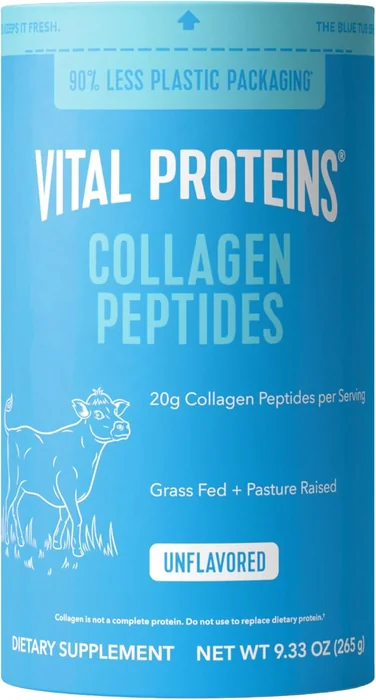
If you'd rather have the ingredient the trials used than the drink from the videos, this is a plain example: bovine collagen peptides, unflavored, 20 g per serving, a full Supplement Facts panel and no botanical blend. When we rechecked on October 8, 2026, the 9.33 oz tub (13 servings) was $18.65 for a one-time purchase, in stock, shipped by Amazon and sold by Vital Proteins. Amazon marks it non-returnable for food-safety reasons, so check the size before ordering.
See it on Amazon →As an Amazon Associate, Mind Vitality News earns from qualifying purchases. Plain link: amazon.com/dp/B09RQBHRCT. Price and availability are as observed on the date above and may change.
Sources
- Butler KD Jr, Hintz HF. Effect of level of feed intake and gelatin supplementation on growth and quality of hoofs of ponies. Journal of Animal Science, 1977;44(2):257–261. PMID 833063. pubmed.ncbi.nlm.nih.gov/833063
- HorseBoost Gummies launch press release, GlobeNewswire, July 3, 2026 (distributor: Instituto Experience, Lakeland, FL), syndicated July 4, 2026 in The Manila Times newswire section; the label figures quoted (82 mg blend, 5 mg caffeine) come from that release. The press release and the HorseFil storefront pages were opened in October 2026 and are deliberately not linked.
- León-López A, et al. Hydrolyzed collagen: sources and applications. Molecules, 2019;24(22):4031. PMID 31703345. pubmed.ncbi.nlm.nih.gov/31703345
- Zambuto SG, et al. Evaluation of gelatin bloom strength on gelatin methacryloyl hydrogel properties. Journal of the Mechanical Behavior of Biomedical Materials, 2024;154:106509. PMID 38518513. pmc.ncbi.nlm.nih.gov/articles/PMC12662645
- USDA FoodData Central, "Gelatins, dry powder, unsweetened" (FDC ID 169599, SR Legacy): 85.6 g protein and 0 g tryptophan per 100 g; 7 g per envelope. fdc.nal.usda.gov/food-details/169599
- Iwasaki Y, et al. Comparison of gelatin and low-molecular weight gelatin hydrolysate ingestion on hydroxyproline (Hyp), Pro-Hyp and Hyp-Gly concentrations in human blood. Food Chemistry, 2022;369:130869. PMID 34461513. pubmed.ncbi.nlm.nih.gov/34461513
- Shaw G, et al. Vitamin C-enriched gelatin supplementation before intermittent activity augments collagen synthesis. American Journal of Clinical Nutrition, 2017;105(1):136–143. PMID 27852613. pubmed.ncbi.nlm.nih.gov/27852613
- Collagen. The Nutrition Source, Harvard T.H. Chan School of Public Health. nutritionsource.hsph.harvard.edu/collagen
- de Miranda RB, Weimer P, Rossi RC. Systematic review and meta-analysis of oral hydrolyzed collagen trials (19 RCTs, 1,125 participants; outcomes included skin hydration and elasticity). International Journal of Dermatology, 2021;60(12):1449–1461. PMID 33742704. pubmed.ncbi.nlm.nih.gov/33742704
- Pu SY, et al. Systematic review and meta-analysis of oral collagen trials (26 RCTs, 1,721 participants; outcomes: skin hydration and elasticity). Nutrients, 2023;15(9):2080. PMID 37432180. pubmed.ncbi.nlm.nih.gov/37432180
- Clark KL, et al. 24-week study on the use of collagen hydrolysate as a dietary supplement in athletes with activity-related joint pain. Current Medical Research and Opinion, 2008;24(5):1485–1496. PMID 18416885. pubmed.ncbi.nlm.nih.gov/18416885
- König D, et al. Specific collagen peptides improve bone mineral density and bone markers in postmenopausal women: a randomized controlled study. Nutrients, 2018;10(1):97. PMID 29337906. pubmed.ncbi.nlm.nih.gov/29337906
- Zdzieblik D, et al. Randomized controlled trial of collagen peptide supplementation with 12 weeks of resistance training in older men with low muscle mass. British Journal of Nutrition, 2015;114(8):1237–1245. PMID 26353786. pubmed.ncbi.nlm.nih.gov/26353786
- Dietary Supplement Labeling Guide. U.S. Food and Drug Administration. fda.gov