
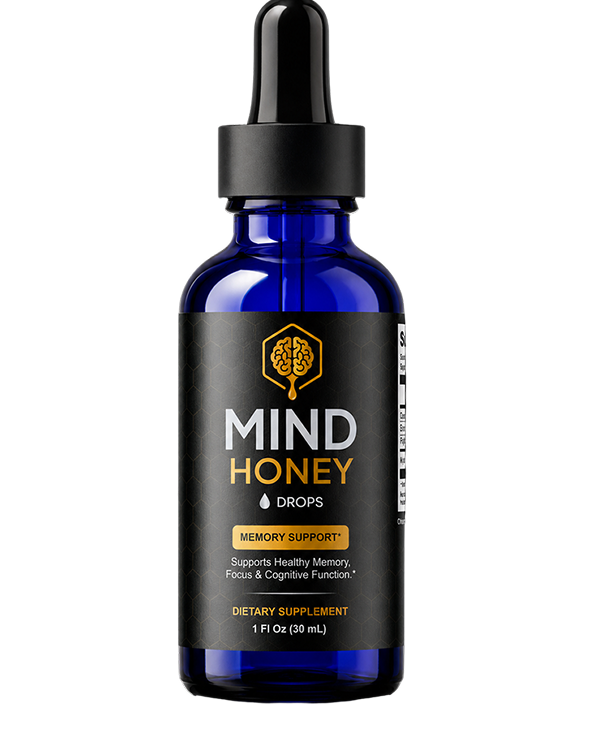
What it actually is
MindHoneyTrick is sold under the brand "Mind Honey," a liquid-drop supplement (not a capsule) marketed at mindhoneytrick.com in 2-, 3-, and 6-bottle packages at $79, $69, and $49 per bottle respectively — $158, $207, and $294 total — with a 60-day money-back guarantee handled through the vendor's own contact page. The ingredient list published on the site and printed on the bottle label is Methylene Blue, Zinc (as Zinc Citrate), Potassium (as Potassium Chloride), Purified Water, Sodium Benzoate, and Potassium Sorbate. That's the complete formula: no honey, no cinnamon, and no per-serving dose disclosed for any of the three active ingredients. The product photo itself, reproduced above, is a plain bottle shot with no doctor or lab-coat imagery.
Things worth knowing before you decide
The vendor's page carries a real inconsistency we could verify directly in its own source code: its og:description and Twitter Card tags describe the product as something that helps "reduce swelling, target leg fat, and support healthy circulation" — copy that reads like a leftover from a different, leg-circulation product — while the actual page content is entirely about memory and mental focus. Metadata that doesn't match the page is a common sign of a funnel site built from a reused template rather than written fresh for this specific bottle.
One of the four testimonials on the page is credited to "Margaret S., 49, North Carolina," but the quote itself opens with "I'm 68 and had started forgetting names at church…" — a 19-year gap between the age stated inside the quote and the age printed under the name. We can't say the testimonial is invented outright, but a genuine customer quote shouldn't contradict its own byline.
When we tested the site's own "Most Popular" 6-bottle checkout link on Sept 5, 2026, it routed to mind-honey-trick.mycartpanda.com and returned a "Tienda no disponible" (store unavailable) page instead of a working checkout — the exact purchase path the vendor's own site points to wasn't functioning at the time we checked.
The bigger concern is the one ingredient the formula does name specifically: Methylene Blue. It's an FDA-approved drug used to treat a specific blood condition (methemoglobinemia), and in October 2011 the FDA issued a Drug Safety Communication warning that methylene blue can cause serious, sometimes fatal serotonin syndrome when combined with SSRIs, SNRIs, tricyclic antidepressants, MAOIs, triptans, or St. John's Wort. MindHoneyTrick's own FAQ tells buyers only to "consult your healthcare professional" if pregnant, nursing, or on prescription medication — it doesn't name this specific interaction, and it doesn't disclose how much methylene blue is actually in a daily serving of drops.
The company address printed in the site's footer — 19655 E 35th Drive, Suite 100, Aurora, CO 80011 — is also used by several other, unrelated-sounding supplement brands we found registered or reviewed at that same suite. No manufacturer or company name specific to Mind Honey is disclosed anywhere on the vendor's own site.
MindHoneyTrick's own checkout domain — mind-honey-trick — directly echoes "the honey trick," the viral phrase behind a real, well-documented scam: AI deepfake videos using the likenesses of Bill Gates, Dr. Sanjay Gupta, Anderson Cooper, and Bruce Willis to push honey-based memory "cures" under a rotating set of brand names, reported by Snopes, Forbes, NBC Chicago, and the Better Business Bureau, and covered in our own Deep Dive on the cinnamon-and-honey memory cure — the same scam family we found this site's own MemoHoney page connected to by name. That reporting names brands including Brain Honey, CogniHoney, IQHoney, Mind Boost, and Memopezil. We specifically searched for "MindHoneyTrick" and "Mind Honey" by name in that reporting and in scam-tracking sites and didn't find either one named directly, so we can't call this a confirmed member of that scam family. What we can confirm: it shares that family's naming convention, its exact three-tier pricing ($158/$207/$294), a MyCartPanda checkout, and a formula that — like several of the products named in that reporting — has nothing to do with the honey or cinnamon its name implies.
A verified alternative, addressing the same gap
The claim MindHoneyTrick is selling — better memory and mental clarity — does have a real, dose-disclosed option behind it, just not this product. A systematic review of randomized, placebo-controlled human trials found standardized Bacopa monnieri extract (300–450 mg/day, taken for about 12 weeks) improved verbal learning and delayed recall compared with placebo. That's modest evidence, not a cure, but it comes with a milligram dose you can check on the label — something MindHoneyTrick's own site never provides for any of its three ingredients.
See it on Amazon →As an Amazon Associate, Mind Vitality News earns from qualifying purchases. This link opens a live Amazon search for this ingredient, not one specific listing we control — check the label for a standardized extract with a disclosed milligram dose, and prices and sellers may vary.
FAQ
- Where is MindHoneyTrick actually sold?
- Under the name "Mind Honey" at mindhoneytrick.com, with checkout handled on a MyCartPanda-hosted subdomain, mind-honey-trick.mycartpanda.com.
- Does it contain honey or cinnamon?
- No. The disclosed formula is Methylene Blue, Zinc (as Zinc Citrate), and Potassium (as Potassium Chloride), plus purified water and two preservatives — no honey-derived ingredient of any kind, and no cinnamon.
- Is this the same product as the deepfake "cinnamon and honey" Alzheimer's scam ads?
- We didn't find "MindHoneyTrick" or "Mind Honey" named in any independent report on that scam pattern. It shares the naming convention, pricing tiers, and checkout platform documented across products that are named in that reporting (Brain Honey, CogniHoney, Mind Boost, Memopezil), but we can't confirm a direct link one way or the other. See our Deep Dive on the cinnamon-and-honey memory cure for the fully documented scam pattern, independent of this specific product.
- Is methylene blue safe to take as a daily supplement?
- It carries a real, FDA-flagged risk: combining it with SSRIs, SNRIs, MAOIs, tricyclic antidepressants, triptans, or St. John's Wort can cause serotonin syndrome, a reaction that can be fatal. Anyone taking those medications should talk to a prescriber before using this, and the seller doesn't disclose a per-serving dose to help gauge that risk.
- What should I take instead?
- We're pointing readers to a standardized Bacopa monnieri extract with a disclosed dose — see the alternative box above.
Sources
- Direct review of mindhoneytrick.com (formula, pricing, guarantee terms, metadata, testimonials) and its checkout at mind-honey-trick.mycartpanda.com, tested Sept 5, 2026.
- FDA Drug Safety Communication, Oct. 20, 2011: "FDA warns of possible harm from combining tramadol and methylene blue, and methylene blue and certain psychiatric medications" — serotonin syndrome risk with SSRIs, SNRIs, MAOIs, tricyclic antidepressants, and other serotonergic drugs.
- Snopes, "Bill Gates isn't backing 'Brain Honey,' other alleged Alzheimer's remedies. They're scams."
- NBC Chicago and Better Business Bureau reporting on the AI deepfake "Bill Gates brain honey" Alzheimer's-cure scam pattern (Bill Gates, Dr. Sanjay Gupta, Anderson Cooper, Bruce Willis likenesses).
- Forbes, "There's No Such Thing As Brain Honey — Dementia 'Cure' Is A Scam."
- Business-listing search (Yelp, local directories) for 19655 E 35th Drive, Suite 100, Aurora, CO 80011, showing multiple unrelated supplement brands registered at the same suite.
- Kongkeaw et al., systematic review of randomized controlled trials on Bacopa monnieri's cognitive effects.